

- March 7, 2026
- 12 min read
Many applicants mistakenly believe UK immigration interviews are simple formalities. In reality, 25% of visa refusals stem from poor interview performance, making thorough preparation essential. This guide clarifies what happens during these interviews, the questions you’ll face, and how to prepare effectively. Whether applying for work, family reunion, or study, understanding the process dramatically improves your chances of approval.
Table of Contents
- Introduction To UK Immigration Interviews
- Typical Questions Asked And Why They Matter
- How Interviews Differ By Visa Type
- Common Misconceptions About UK Immigration Interviews
- Preparation Strategies And Cultural Tips For Turkish Applicants
- What Happens After The Interview
- Discover Expert Support For Your UK Visa Journey
- Frequently Asked Questions
Key takeaways
| Point | Details |
|---|---|
| Interview purpose | Assesses your credibility, eligibility, and whether you meet visa requirements through structured questioning. |
| Visa-specific focus | Questions vary by category: skilled worker interviews emphasise job details, family visas verify relationships, student visas examine academic plans. |
| Preparation impact | Mock interviews and document organisation increase approval rates by 30%, making preparation non-negotiable. |
| Document verification | Family visa interviews always include thorough document checks to confirm authenticity and relationship evidence. |
| Refusal risks | Inconsistent answers or inadequate preparation trigger 40% of interview-related refusals. |
Introduction to UK immigration interviews
The UK immigration interview serves as a critical verification step in your visa application journey. Officers use this face-to-face or virtual meeting to confirm your eligibility and assess whether you genuinely meet the requirements for your chosen visa category.
Interviews typically last between 15 and 45 minutes, depending on visa complexity and your specific circumstances. The duration isn’t arbitrary—officers need sufficient time to explore your background, intentions, and supporting evidence thoroughly.
The process follows a structured approach:
- Identity and document verification to confirm you are who you claim to be
- Detailed questioning about your application, background, and UK plans
- Final evaluation where officers assess consistency between your answers and submitted documents
Your performance directly influences the outcome. Officers look for confidence, consistency, and genuine responses that align with your paperwork. Preparation transforms this potentially stressful encounter into an opportunity to demonstrate your suitability for UK entry.
Typical questions asked and why they matter
Interview questions serve multiple purposes beyond surface-level fact-checking. Officers design queries to verify information consistency, assess genuine intentions, and identify any discrepancies that might suggest misrepresentation.
The majority of questions focus on behavioural assessment, with 40% designed to evaluate intentions and consistency rather than simple factual recall. This approach helps officers distinguish between applicants who genuinely meet requirements and those attempting to manipulate the system.
Common question themes include:
- Personal background and history in your home country
- Employment details, including job responsibilities and salary expectations
- Your specific plans in the UK and long-term intentions
- Family connections and support networks
- Financial circumstances and how you’ll support yourself
- Knowledge about your sponsor, employer, or educational institution
Consistency matters enormously. If your verbal answers contradict written statements or supporting documents, officers will investigate further. Minor discrepancies might prompt clarifying questions, but significant inconsistencies often lead to refusal. Prepare by reviewing your application thoroughly and practising answers that align perfectly with submitted evidence.
How interviews differ by visa type
Each visa category demands tailored interview preparation because officers focus on category-specific requirements. Understanding these distinctions helps you prioritise the right information.
For skilled worker visas, 60% of questions relate to your employer and job specifics. Officers want detailed knowledge about your role, daily responsibilities, and why your sponsor needs your particular skills. You’ll need to explain your salary, how it meets minimum thresholds, and your career progression plans. Questions about finding a sponsor in the UK are common, so be ready to discuss how you secured your position and what makes your sponsor credible. The skilled worker visa changes in 2025 introduced new requirements that officers will verify during interviews.

Family visa interviews emphasise relationship authenticity and document verification. Officers scrutinise how you met, your relationship timeline, and evidence of genuine partnership. Expect questions about daily routines, shared finances, and future plans together. Document verification is mandatory—officers examine original certificates, photographs, and correspondence.
Student visas concentrate heavily on academic intentions, with 75% of questions focused on educational goals and financial proof. Officers assess whether you understand your course content, why you chose that specific institution, and how the qualification advances your career. Financial questions verify you can afford tuition and living costs without working illegally.
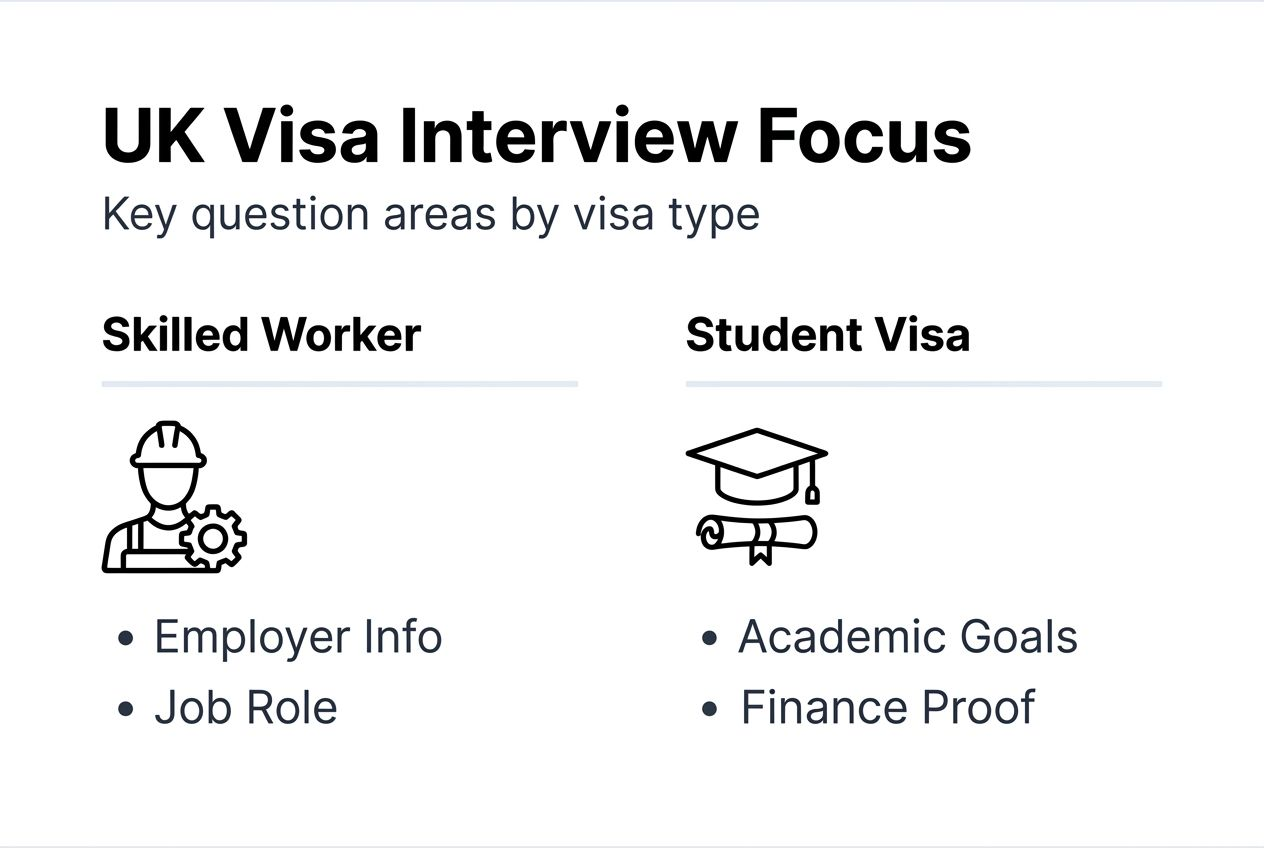
| Visa type | Primary focus | Key question areas |
|---|---|---|
| Skilled worker | Job and sponsor details (60%) | Role responsibilities, salary, sponsor credibility |
| Family | Relationship authenticity | Meeting history, daily life, shared evidence |
| Student | Academic plans (75%) | Course knowledge, institution choice, financial capacity |
Pro tip: Research your sponsor, institution, or family circumstances thoroughly before the interview. Officers can detect superficial knowledge immediately, and detailed, confident answers demonstrate genuine eligibility.
For additional guidance on visa categories and requirements, explore our UK immigration insights blog or review the official skilled worker visa interview guide and student visa interview guide.
Common misconceptions about UK immigration interviews
Several persistent myths create unrealistic expectations and inadequate preparation. Correcting these misunderstandings improves your approach and success prospects.
Many applicants believe interviews are mere formalities, assuming approval is guaranteed once documents are submitted. This dangerous misconception ignores the reality that 25% of visa refusals link directly to interview failures. Officers use interviews as decisive evaluation tools, not rubber-stamp exercises.
Another common myth suggests family visa interviews skip document verification if paperwork looks complete. In truth, every family visa interview includes thorough document checks. Officers examine originals, compare them against copies, and verify authenticity through multiple methods.
Some applicants assume preparation doesn’t significantly impact outcomes, believing natural responses suffice. Research contradicts this assumption—structured preparation dramatically improves approval rates by helping you present consistent, confident answers.
The belief that interviews only test factual knowledge overlooks the behavioural assessment component. Officers evaluate body language, response patterns, and whether your demeanour matches someone telling the truth.
“The interview isn’t about reciting facts from your application. It’s about demonstrating genuine eligibility through consistent, credible responses that align with your documented evidence.”
Key misconceptions to avoid:
- Assuming the interview is a formality with no real impact
- Believing document verification only happens during initial application review
- Thinking preparation offers minimal benefit compared to natural responses
- Imagining officers only care about factual accuracy, not behavioural cues
Preparation strategies and cultural tips for Turkish applicants
Effective preparation combines practical organisation with cultural awareness to maximise your interview performance. Turkish-speaking applicants benefit from understanding both universal best practices and UK-specific communication expectations.
Mock interviews provide invaluable preparation advantages. Applicants who practise through mock interviews achieve 30% higher success rates because rehearsal builds confidence, identifies weak answers, and improves response consistency. Recruit a friend or family member to play the interviewer role, or seek professional support for structured practice sessions.
Document organisation prevents last-minute panic and demonstrates professionalism. Create a systematic folder containing originals and certified copies of all supporting evidence. Arrange documents chronologically or by category so you can locate any requested item within seconds.
Follow these preparation steps:
- Review your entire application multiple times until details are memorised
- Conduct at least three mock interviews covering different question scenarios
- Prepare concise answers to common questions in your visa category
- Organise all documents with clear labels and easy access
- Research your sponsor, institution, or family circumstances thoroughly
- Plan your interview outfit to present a professional appearance
Non-verbal communication influences 20-25% of the impression you create. Maintain appropriate eye contact without staring, sit with good posture, and avoid excessive fidgeting. UK culture values composed, measured responses over emotional displays.
Cultural communication differences matter. British communication styles tend towards indirect politeness and measured responses. Avoid over-explaining or providing excessive detail—answer questions directly, then pause for follow-up queries. If conducting a video interview, test your technology beforehand, ensure good lighting, and eliminate background distractions.
Pro tip: Prepare specific examples and anecdotes that illustrate your answers. Concrete stories are more memorable and credible than generic statements, helping officers see you as a genuine applicant rather than a theoretical case.
For additional support with finding a job in the UK or understanding UK living advice for Turkish applicants, explore professional resources at UK visa and recruitment services.
What happens after the interview
Understanding post-interview procedures helps manage expectations and prepares you for potential outcomes. Decision timelines vary by visa type and application complexity, typically ranging from a few days to several weeks.
Officers evaluate your performance immediately after the interview, comparing your verbal responses against submitted documentation. They look for consistency, credibility, and whether you demonstrated genuine eligibility. Strong interviews where answers align perfectly with paperwork typically result in faster approvals.
Inconsistent or contradictory answers create serious concerns. Research indicates that interview inconsistencies increase refusal risk by 40%, as officers interpret discrepancies as potential misrepresentation. Even minor contradictions prompt additional scrutiny and may delay decisions while officers investigate further.
If your visa is refused, you’ll receive a detailed explanation outlining the specific reasons. Common interview-related refusal grounds include:
- Significant inconsistencies between verbal answers and written application
- Inability to demonstrate genuine eligibility or intentions
- Failure to provide satisfactory evidence when questioned
- Poor knowledge of key details about your sponsor, partner, or institution
Refusals aren’t necessarily permanent. You can appeal certain decisions through the appropriate tribunal, though strict deadlines apply. Alternatively, you may submit a fresh application addressing the weaknesses identified in your refusal letter. If interview performance caused the refusal, invest in better preparation before reapplying.
Decision notifications arrive via email or post, depending on your application method. Check your email regularly, including spam folders, to avoid missing important communications. If approved, follow the instructions for collecting your visa or biometric residence permit promptly.
Discover expert support for your UK visa journey
Navigating UK immigration requirements demands expertise, particularly when interview preparation can make or break your application. Professional guidance transforms complex processes into manageable steps, significantly improving your approval prospects.
At UK Visa Assistance, we specialise in comprehensive immigration support tailored to Turkish-speaking applicants. Our services cover everything from initial application preparation to interview coaching, ensuring you present the strongest possible case. We’re regulated by the Immigration Advice Authority, providing peace of mind that you’re receiving qualified, trustworthy guidance.
Whether you’re pursuing skilled worker opportunities, family reunion, or educational goals, our team understands the specific requirements and cultural nuances that affect Turkish applicants. We offer detailed support on self-sponsorship visa options, finding a sponsor in the UK, and navigating the complete visa process from start to finish. Visit UK visa and recruitment services to explore how we can support your immigration journey.
Frequently asked questions
What is a UK immigration interview?
A UK immigration interview is a structured meeting where Home Office officials verify your eligibility and assess whether you genuinely meet the requirements for your visa category. Officers ask detailed questions about your background, intentions, and supporting evidence to confirm consistency with your written application. The interview typically lasts 15-45 minutes and occurs either in person at a visa application centre or via video call, depending on your location and visa type.
How do interviews differ by visa type?
Skilled worker visa interviews concentrate heavily on employment details, with 60% of questions focused on your job role, responsibilities, and sponsor credibility. Family visa interviews emphasise relationship authenticity, requiring detailed knowledge of your partner and thorough document verification. Student visa interviews dedicate 75% of questions to academic plans, institution knowledge, and financial capacity. Each category demands tailored preparation focusing on the specific evidence requirements that matter most for that visa type.
What documents should I bring to my UK immigration interview?
Bring original versions of all documents submitted with your application, including passport, educational certificates, employment contracts, bank statements, and relationship evidence if applicable. Prepare certified translations for any documents not in English. Organise everything systematically so you can locate requested items immediately. Family visa applicants need additional original marriage certificates, birth certificates, and photographic evidence. Having well-organised, accessible documents demonstrates professionalism and preparedness.
How should I prepare specifically for a skilled worker visa interview?
Focus your preparation on detailed knowledge of your employer, job role, and why your sponsor needs your specific skills. Practise explaining your daily responsibilities, salary details, and career progression plans confidently. Research your sponsor’s business thoroughly, including their industry position and why they’re a credible employer. Review how you secured the position and be ready to discuss the process of finding a sponsor in the UK if asked.
What are common mistakes to avoid during the UK immigration interview?
Avoid providing inconsistent answers that contradict your written application or supporting documents, as discrepancies raise immediate red flags. Don’t arrive unprepared with disorganised documents or vague knowledge about key details. Never treat the interview as a mere formality—officers notice lack of preparation instantly. Avoid over-explaining or providing excessive unsolicited information, which can create unnecessary complications. Stay focused, answer questions directly, and maintain confident but measured responses throughout.
Can I appeal if my visa is refused after the interview?
Yes, you can appeal certain visa refusals through the appropriate tribunal, though strict deadlines apply and not all refusal types qualify for appeal. Review your refusal letter carefully to understand specific grounds and whether appeal rights exist. Alternatively, submit a fresh application addressing the weaknesses identified in your refusal, particularly if interview performance caused the rejection. If inconsistent answers triggered the refusal, invest in thorough preparation and possibly professional coaching before reapplying to avoid repeating the same mistakes.
Recommended
- Skilled Worker Vizesinde Yeni Dönem: 22 Temmuz 2025 Sonrası Ne Değişiyor? Kimler gelebilir? Eskiden gelenler için Vize Uzatma Nasıl Olacak? – METIN.LONDON
- Title: Unlocking Opportunities: A Comprehensive Guide to the Global Talent Visa in the UK – METIN.LONDON
- Finding a Job in the UK: A Guide for Foreigners – METIN.LONDON
- Information for internationally trained Nurse applicants – METIN.LONDON


