

Navigating UK visa English requirements can feel overwhelming, especially when you encounter different IELTS test types and CEFR levels for each visa category. Many Turkish applicants struggle to determine which English language test they need and what score qualifies them for their desired visa route. This comprehensive guide clarifies exactly what IELTS requirements you must meet for family, student, and skilled worker visas in 2026, helping you prepare with confidence and avoid costly application mistakes.
Table of Contents
- English Language Requirements Framework For UK Visas
- IELTS Requirements For Family Visas
- IELTS Requirements For Student Visas
- IELTS Requirements For Skilled Worker Visas
- Explore Visa And Recruitment Support Services At METIN.LONDON
- Frequently Asked Questions
Key takeaways
| Point | Details |
|---|---|
| IELTS test types | UKVI recognises IELTS Academic, General Training, IELTS for UKVI variants, and Life Skills for different visa routes. |
| CEFR levels by visa | Family visas require A1 or A2, student visas need B1 or B2 depending on study level, skilled worker visas demand B2. |
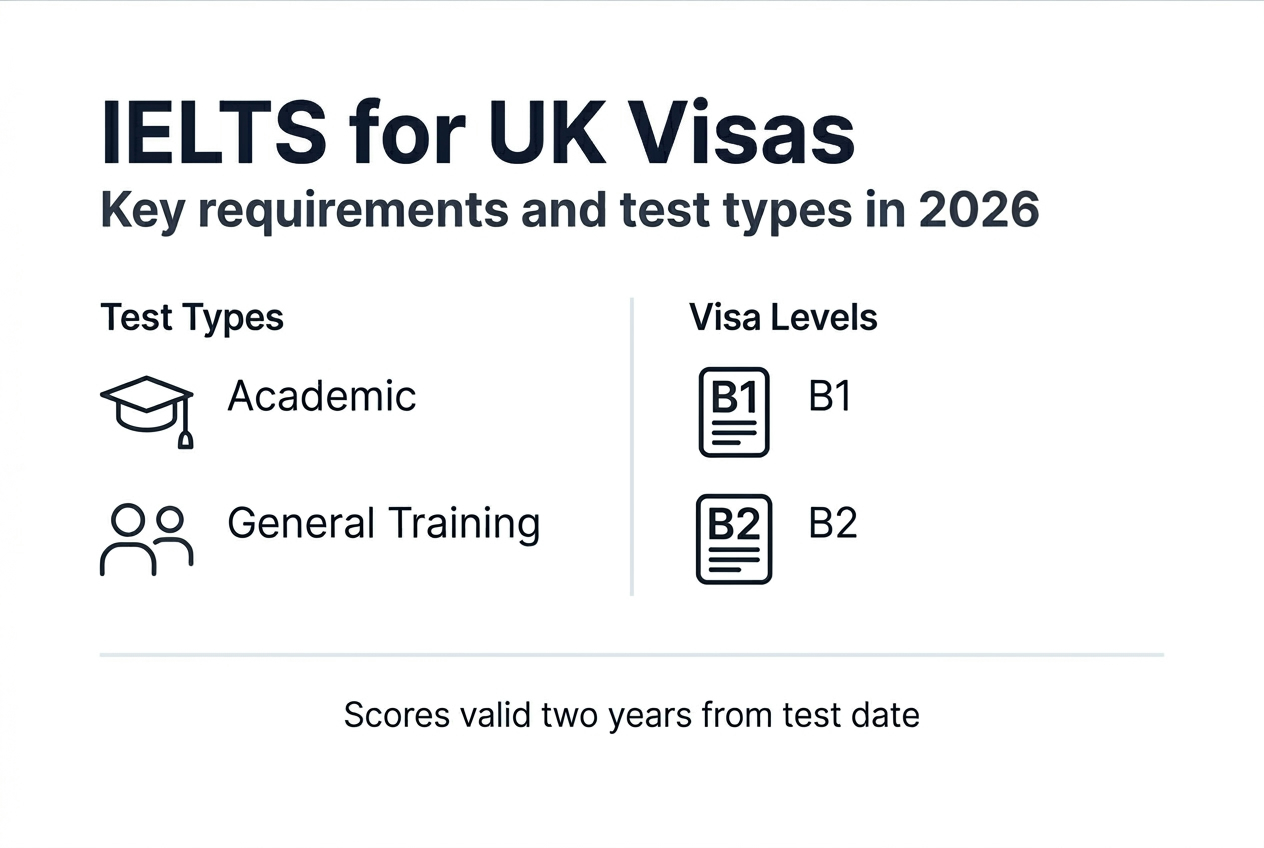
| Score validity | IELTS results remain valid for two years from test date and must be current when you submit your application. |
| Test selection matters | Choosing the wrong IELTS test type for your visa category leads to automatic rejection regardless of your score. |
English language requirements framework for UK visas
English language proficiency levels for UK visa applications are determined by the Common European Framework of Reference for Languages (CEFR), which establishes standardised benchmarks from A1 (beginner) through B2 (upper intermediate). Understanding this framework helps you identify which level your visa category requires and which IELTS test demonstrates that competency.
The UK Visas and Immigration (UKVI) recognises specific IELTS tests for visa applications, functioning as Secure English Language Tests (SELTs) that meet Home Office standards. Not every IELTS test qualifies as a SELT, so you must verify your chosen test appears on the approved provider list before booking.
The UKVI accepts these IELTS formats:
- IELTS Academic for UKVI (primarily for students)
- IELTS General Training for UKVI (for work and migration routes)
- IELTS Life Skills (speaking and listening only, mainly for family visas)
- Standard IELTS Academic or General Training (limited visa categories)
Your IELTS scores remain valid for two years from the test date, meaning you must hold current results when submitting your visa application. If your test certificate expires before you apply, you must retake the exam regardless of your previous score. Planning your test timing prevents last-minute scrambles and ensures your results cover the entire application processing period.
Pro Tip: Book your IELTS test at least three months before your intended visa application date to allow time for retakes if needed and ensure results remain valid throughout processing, especially if you require professional property inspection reports for UK visas alongside your language evidence.
IELTS requirements for family visas
Family visa applicants require different CEFR levels for entry clearance and permission to stay, creating distinct pathways depending on whether you apply from outside the UK or extend your stay from within. Entry clearance applications for spouse, partner, fiancé, or dependent visas typically require A1 level English, representing basic communication skills.
If you already hold family permission and seek to extend your stay, you must demonstrate A2 level proficiency, which shows slightly more advanced language ability. This progression encourages family members to improve their English skills whilst living in the UK, supporting better integration into British society.
IELTS Life Skills is often used for family visas because it focuses exclusively on speaking and listening at A1 or A2 levels, making it shorter and more affordable than full IELTS tests. The Life Skills test lasts approximately 20 minutes and assesses your ability to understand spoken English and communicate in everyday situations.
Follow these steps to prepare your family visa English evidence:
- Determine whether you need A1 (entry clearance) or A2 (extension) based on your application type and current immigration status.
- Book an IELTS Life Skills test at A1 or A2 level through an approved UKVI test centre, ensuring availability in your location.
- Practise speaking and listening skills using official preparation materials that mirror the test format and question types.
- Attend your test appointment with valid identification and receive your results within seven days of completion.
- Include your IELTS certificate with your visa application, verifying the test date falls within the two year validity window.
Before selecting your test, confirm which IELTS variant your specific family visa route accepts, as some categories permit standard tests whilst others mandate UKVI versions. Dependent visa UK requirements provide additional context for family members accompanying main applicants.
IELTS requirements for student visas
Student visa applicants have different requirements based on their level of study, reflecting the language demands of various academic programmes. Courses below bachelor’s degree level require B1 CEFR proficiency, whilst bachelor’s degrees and postgraduate programmes demand B2 level competency.
B1 level demonstrates intermediate English skills suitable for foundation programmes, diploma courses, and pre-sessional language studies. You can understand main points in clear standard speech, handle most situations whilst travelling, and produce simple connected text on familiar topics.
B2 level represents upper intermediate proficiency necessary for degree-level study taught entirely in English. Students at this level comprehend complex texts, interact fluently with native speakers, and produce detailed writing on diverse subjects with clear reasoning.

IELTS Academic serves as the standard test for student visa applications because it assesses academic English skills through reading passages, essay writing, and formal discussion tasks that mirror university environments. Universities often specify minimum overall scores and individual component scores (reading, writing, listening, speaking) that exceed basic visa requirements.
Prepare for IELTS Academic using these approaches:
- Familiarise yourself with academic vocabulary and formal writing structures used in essays and reports.
- Practise reading lengthy academic texts quickly whilst identifying main arguments and supporting evidence.
- Develop listening skills for lectures and academic discussions featuring multiple speakers and complex ideas.
- Build speaking confidence by discussing abstract topics and presenting structured arguments with examples.
Pro Tip: Take your IELTS Academic test four to five months before your course start date so results remain valid throughout your visa application process and arrival in the UK, giving you buffer time if you later want to switch from student visa to skilled worker visa after graduation.
IELTS requirements for skilled worker visas
Skilled Worker visa applicants generally require B2 level English proficiency to work in professional roles across the UK economy. This standard ensures workers can communicate effectively with colleagues, understand workplace safety instructions, and participate fully in team environments.
Skilled Worker visa applicants must demonstrate English language proficiency through IELTS for UKVI Academic or General Training tests, with General Training being more common for work-focused applications. The test evaluates real-world English abilities relevant to employment contexts rather than purely academic scenarios.
Compare CEFR levels and typical IELTS scores for skilled worker applicants:
| CEFR Level | Overall IELTS Score | Reading | Writing | Listening | Speaking |
|---|---|---|---|---|---|
| B1 | 4.0-5.0 | 4.0+ | 4.0+ | 4.0+ | 4.0+ |
| B2 | 5.5-6.5 | 5.5+ | 5.5+ | 5.5+ | 5.5+ |
Whilst B2 represents the standard requirement, some occupations coded at RQF Level 3 or below may accept B1 proficiency, particularly in sectors facing labour shortages. Check your specific job’s Standard Occupational Classification (SOC) code and corresponding English level before booking your test.
Your sponsoring employer might also set higher English requirements than the visa minimum, especially for client-facing roles or positions requiring advanced communication skills. Confirm both Home Office and employer expectations to avoid taking multiple tests.
Pro Tip: Align your IELTS preparation with your job sector vocabulary and workplace scenarios, focusing on the communication tasks your role demands, then explore UK skilled worker visa salary requirements and skilled worker jobs for Turkish applicants to maximise your application competitiveness.
IELTS for UKVI General Training or Academic both satisfy skilled worker visa English requirements, so choose based on which test format suits your strengths and preparation timeline. General Training features more practical reading passages and letter-writing tasks, whilst Academic includes scholarly texts and formal essays.
Explore visa and recruitment support services at METIN.LONDON
Understanding IELTS requirements represents just one element of successful UK visa applications. METIN.LONDON provides comprehensive immigration guidance regulated by the Immigration Advice Authority (IAA), helping Turkish applicants navigate language requirements alongside financial evidence, sponsorship certificates, and documentation standards.
Our expert team supports family visa applicants preparing English test evidence, students selecting appropriate IELTS levels for their courses, and skilled workers aligning language scores with employer expectations. We also specialise in self-sponsorship visa routes for entrepreneurs establishing UK businesses and dependent visa requirements for family members joining main applicants. Visit METIN.LONDON to access detailed visa guides and professional application assistance tailored to your immigration goals.
Frequently asked questions
What IELTS tests are accepted for UK visas?
The UKVI recognises IELTS Academic, IELTS General Training, IELTS for UKVI Academic and General Training, and IELTS Life Skills for visa applications, with specific tests required for different visa categories. Family visas typically accept Life Skills, student visas require Academic variants, and skilled worker visas permit General Training or Academic for UKVI tests.
How long are IELTS results valid for UK visa applications?
IELTS scores are valid for two years from the test date and must be valid at the time of visa application. If your certificate expires before you submit your application or during processing, you must retake the test regardless of your previous score. Plan your test timing to ensure results cover your entire application period.
Can I use IELTS Life Skills test for a skilled worker visa?
IELTS Life Skills is often used for family visas but not for skilled worker visas because it only assesses speaking and listening at A1 or A2 levels. Skilled worker routes require B2 proficiency demonstrated through IELTS for UKVI Academic or General Training tests that evaluate all four language skills.
Do all UK visa categories require IELTS tests?
Not all visa routes mandate IELTS tests, as some applicants qualify for exemptions based on nationality, previous UK study, or degree-level qualifications taught in English. Citizens of majority English-speaking countries and holders of degrees from UK institutions may satisfy English requirements without taking IELTS.
What happens if I fail my IELTS test for a UK visa?
Failing to achieve the required IELTS score means you cannot proceed with your visa application until you retake the test and obtain qualifying results. You can retake IELTS as many times as needed, though you must wait a reasonable period between attempts and pay the test fee each time.


